
Edge AI in Agriculture with mmWave Radar Development Platforms
AGRICULTURE
Anup Halarnkar
2/20/20261 min read
Introduction: The Future of Smart Farming is Radar + Edge AI
Modern agriculture is rapidly evolving with precision farming technologies. However, many irrigation and crop monitoring decisions still rely on manual inspection or camera-based systems that require stable internet connectivity.
mmWave radar development platforms are now changing this landscape.
By combining non-contact radar sensing with ARM-based Embedded Linux single-board computers (SBCs) running on-device machine learning models, farmers can deploy localized Edge AI systems that work even in low-network rural zones.
This article explores how mmWave radar evaluation kits can transform agriculture through real-time, cloud-independent intelligence.
What is mmWave Radar?
Sensor Type: Non-Contact Radar Sensing (60–77 GHz)
Millimeter Wave (mmWave) radar sensors transmit high-frequency radio waves and analyze the reflected signals to determine:
Distance (range)
Velocity (Doppler shift)
Object angle (Angle of Arrival)
Micro-movement signatures
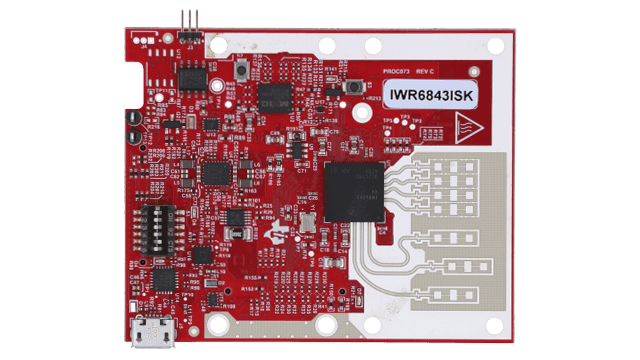
Unlike cameras or optical sensors, mmWave radar is rugged and,
Works in dust, fog, and rain
Operates in complete darkness
Does not depend on lighting conditions
Requires minimal maintenance
Preserves privacy (no image capture)
This makes it ideal for harsh agricultural environments.
Key Agricultural Applications of mmWave Radar Development Platforms
1 ) Crop Growth Monitoring:
mmWave radar can continuously measure crop canopy growth and height without touching the plants.
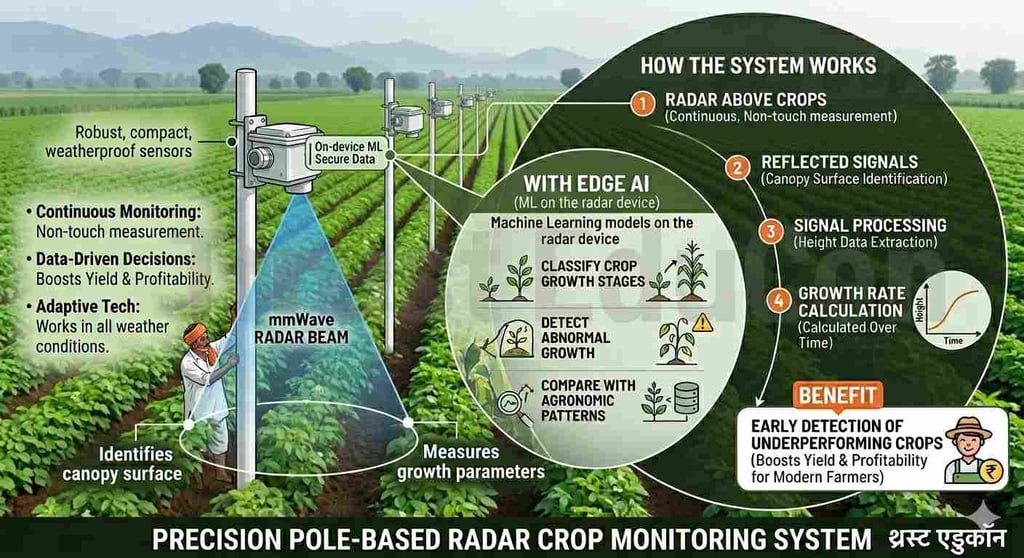
How the Radar System works:
Radar is mounted above crop rows.
Reflected signals identify the canopy surface.
Signal processing extracts height data.
Growth rate is calculated over time.
With Edge AI:
On the device; machine learning models can:
Classify the crop growth stages
Detect abnormal growth
Compare with expected agronomic patterns
Benefit: This enables early detection of underperforming crops
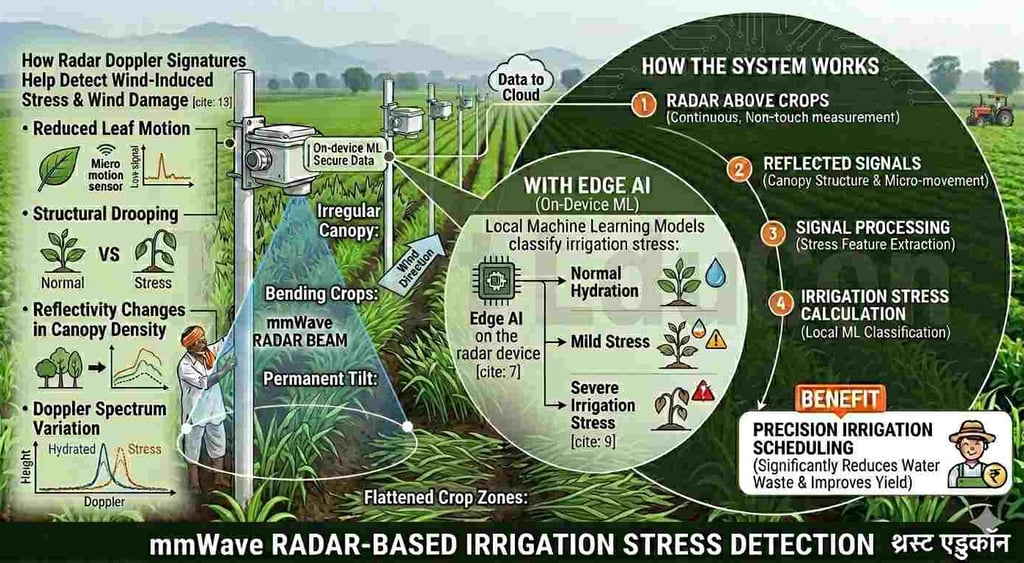
2 ) Irrigation Stress Detection:
Water stress causes subtle structural and micro-movement changes in plants.
mmWave radar can detect:
Reduced leaf motion
Structural drooping
Reflectivity changes in canopy density
Doppler spectrum variation
With Edge AI:
Local ML models can classify:
Normal hydration
Mild stress
Severe irrigation stress
Benefit: This enables precision irrigation scheduling and significantly reduces water waste.
3) Wind Damage and Crop Lodging Detection:
Strong winds can cause:
Bending of crops
Permanent tilt (lodging)
Irregular canopy oscillation
Radar Doppler signatures help detect:
Abnormal vibration patterns
Structural instability
Flattened crop zones
Benefit: Insurance assessment, Yield forecasting and Early corrective action
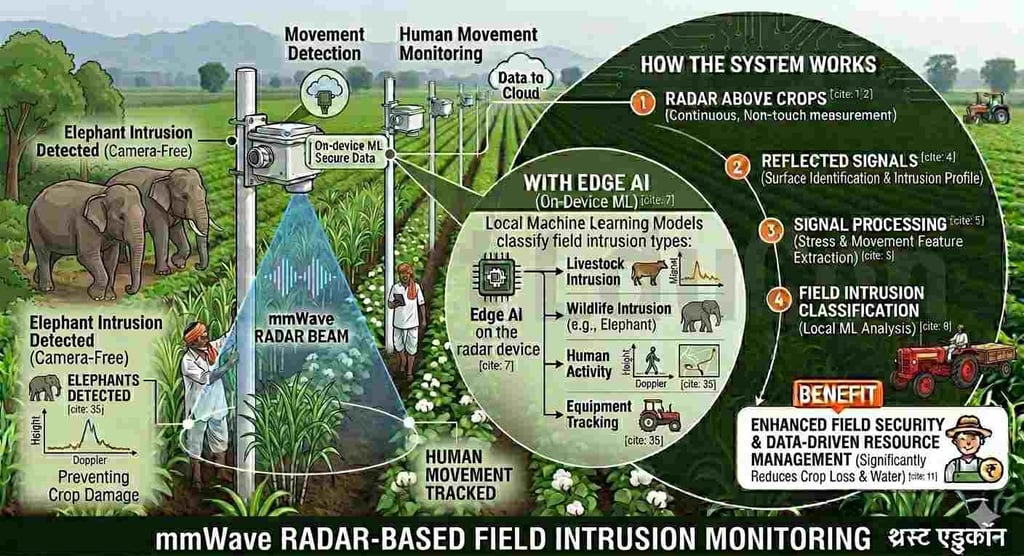
4) Field Intrusion Monitoring
Without the need for Cameras, the mmWave radar systems can:
Detect livestock intrusion
Monitor human movement
Track equipment activity
Prevent wildlife crop damage
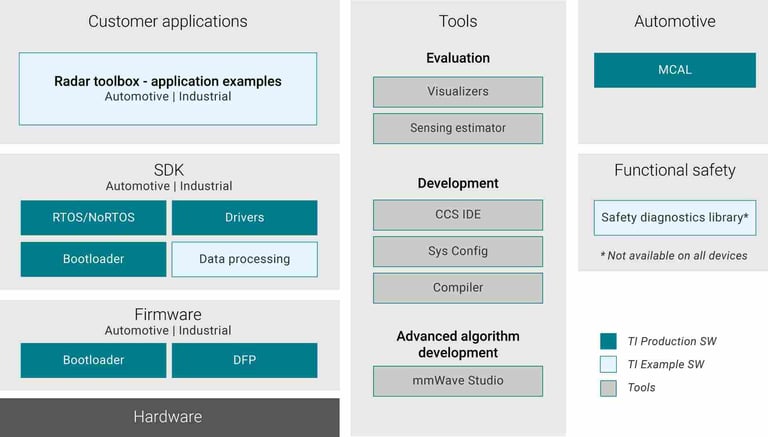
Edge AI Architecture for Agricultural Deployment
1) Hardware Stack
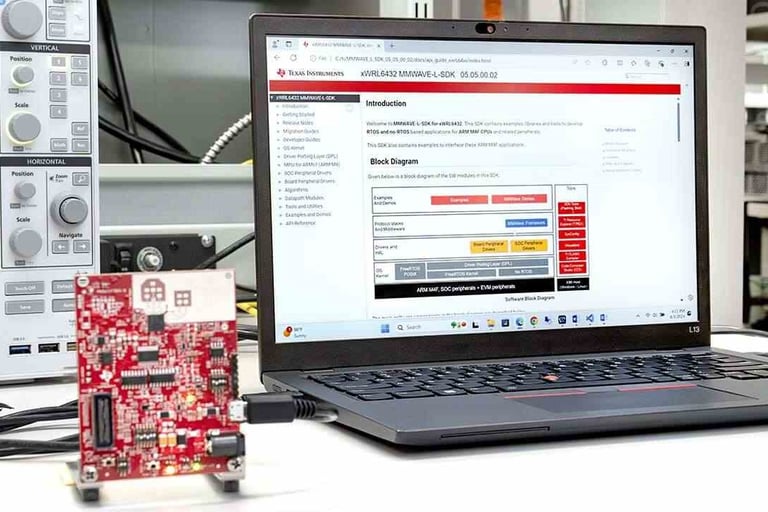
mmWave Radar Evaluation Kit
ARM-based SBC (BeagleBone, i.MX8, Raspberry Pi CM4)
Embedded Linux (Debian based)
Local storage (eMMC/SD card)
Optional LoRa or LTE connectivity
Solar power support (for remote farms)
2) Software Pipeline
Step 1: Radar Data Acquisition
Raw radar signals are processed into,
Range FFT
Doppler FFT
Point cloud data
Step 2: Feature Extraction
A list of key features include:
Height variance
Reflectivity density
Doppler spread
Motion periodicity
Step 3: On-Device Machine Learning
Using frameworks such as TensorFlow Lite, ONNX Runtime and Custom C/C++ inference engines, models can perform:
Growth stage classification
Stress anomaly detection
Biomass regression estimation
Social Impact: Water Conservation in Drought-Prone Regions
Water scarcity is a major concern in semi-arid agricultural regions.
Localized mmWave radar + Edge AI systems can:
Reduce water usage by 15–30%
Optimize irrigation timing
Enable precision farming without cloud dependence
Support sustainable agricultural practices
Benefit: By eliminating continuous cloud dependency, farmers in remote areas gain access to advanced AI without requiring broadband infrastructure.
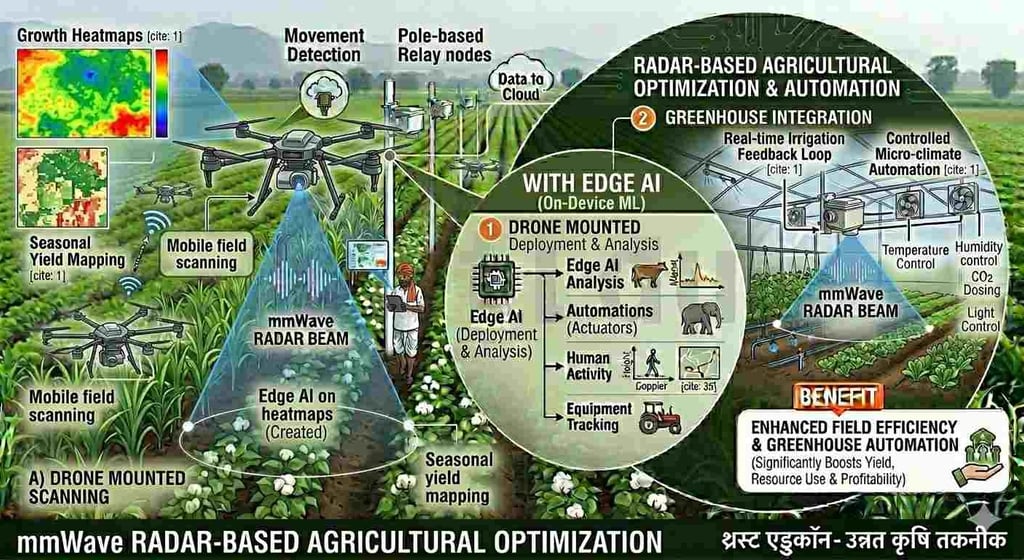
Deployment Models
1) Fixed Pole Installation
Radar mounted 2–3 meters above canopy
Covers 5–20 meter radius
Solar-powered operation
Periodic data upload
2) Drone mounted scanning
Mobile field scanning
Creates growth heatmaps
Seasonal yield mapping
3) Green House Integration
Real-time irrigation feedback loop
Controlled micro-climate automation
Future Possibilities
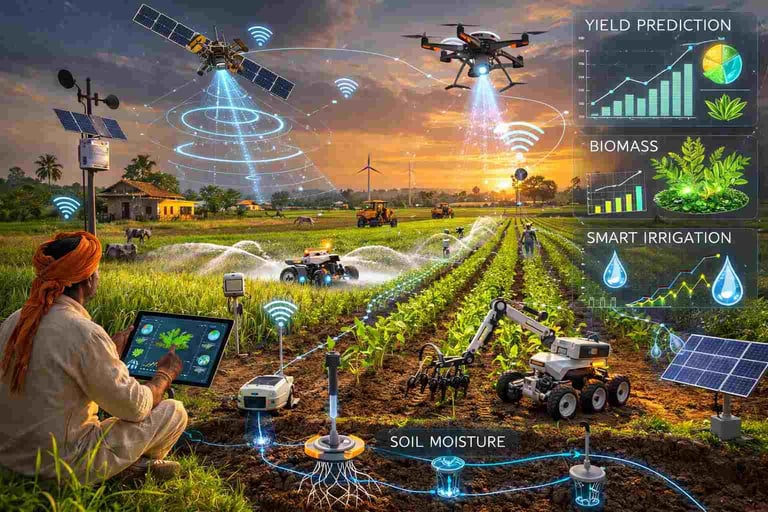
The integration of mmWave radar with Edge AI opens doors for:
Multi-sensor fusion (radar + soil moisture sensors)
Yield prediction models
Biomass estimation
Smart irrigation controllers
Autonomous agricultural robotics
Conclusion:
mmWave radar development platforms enable robust, non-contact agricultural sensing that works in harsh environments and low-connectivity rural areas.
When combined with Embedded Linux systems and on-device AI inference:
Farmers gain real-time insights.
Water usage is optimized.
Crop health is monitored continuously.
Cloud dependency is minimized.
This technology represents a major step toward sustainable, precision-driven agriculture.


Contact
Reach out for collaboration or inquiries
enquiry@thrusteducon.com
© 2025. All rights reserved.